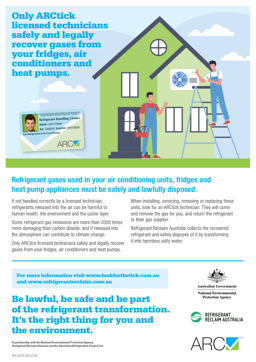
Why Use a Licensed ARCtick Technician
5 min read · Document by Australian Refrigeration Council · Page updated 29 July 2026
Every split system air conditioner contains fluorocarbon refrigerant — and in Australia, working on anything that contains it is restricted by law. The person who installs, services, re-gasses or removes your air conditioner must hold a refrigerant handling licence issued by the Australian Refrigeration Council (ARC). That licence is what the “ARCtick” stands for, and this official ARC handout explains, in one page, why it matters to you as a customer.
This page summarises the handout in plain English, adds the practical questions we get asked in Melbourne homes every week, and gives you the official document to keep. True Line Air Conditioning holds ARCtick licence L227165 and operates under True Line Electrical’s Victorian electrical contractor registration REC 38009 — so this is a standard we are measured against, not just one we recommend.
Key takeaways
- Anyone working on equipment that contains refrigerant must hold an ARC refrigerant handling licence — it's the law, not a preference.
- Licensed technicians carry a photo licence card; ask to see it before work starts.
- Unlicensed work risks sub-par installation, a voided manufacturer's warranty and illegal refrigerant discharge.
- In Victoria a split system also needs a licensed electrician and a Certificate of Electrical Safety — a compliant install carries both credentials.
- True Line Air Conditioning holds ARCtick licence L227165 and operates under REC 38009.
What the ARCtick licence actually is
The ARC administers refrigerant handling licences on behalf of the Australian Government under the Ozone Protection and Synthetic Greenhouse Gas Management legislation. The scheme was introduced in 2005 with a clear purpose: minimise emissions of refrigerant gases that damage the ozone layer and accelerate global warming. Anyone who installs, services or decommissions equipment containing fluorocarbon refrigerant — which includes nearly every household air conditioner — must hold an appropriate ARC licence.
A licensed technician has demonstrated their qualifications, works to an Industry Code of Practice, and can be verified: the ARC issues a photo licence card showing the holder’s name, licence number and expiry date. If a technician can’t show you one, the ARC’s advice is simple — they can’t tick all the boxes.
The real risks of unlicensed work
The ARC handout is blunt about what unlicensed work can cost you. First, quality: an installer who hasn’t met the licensing requirements hasn’t demonstrated they’ll meet their legal obligations either, and sub-par installation usually surfaces later as paid rework. Second, your warranty: manufacturers can void product warranties where work wasn’t performed by appropriately licensed technicians. Third, the leak problem: poorly made refrigerant connections leak, and a leaking system loses performance and costs more to run every single day.
There’s also the legal side. Discharging fluorocarbon refrigerant to the atmosphere is illegal under the Ozone Protection and Synthetic Greenhouse Gas Management Act 1989, with real penalties. Some refrigerants are more than 2,000 times more potent than carbon dioxide as greenhouse gases — a single careless release outweighs years of careful energy saving.
When should you ask to see an ARCtick licence?
Before any work begins on the refrigerant side of your system. In practice that means: a new split system installation, any repair that involves the refrigerant circuit, a re-gas, an annual service that includes performance testing, and the removal or replacement of an old unit (the gas must be recovered before the unit comes off the wall). Asking is normal — a professional expects it. You can also ask for the licence number and check it with the ARC.
One nuance worth knowing in Victoria: the ARCtick licence covers the refrigerant work, but the electrical connection of a split system is separate — it must be done by a licensed electrician who issues a Certificate of Electrical Safety (COES). A complete, compliant installation needs both credentials on site. That’s the reason True Line installs are performed by a licensed electrical team with ARCtick refrigerant licensing, and every installation includes the COES in the published price.
How True Line handles this
Our credentials are printed in the footer of every page of this site: ARCtick licence L227165, Victorian Registered Electrical Contractor REC 38009, and full insurance. Quotes are fixed in writing before work begins, and if you’d like to see the licence card on the day — ask. If you’re comparing installers, our advice is the same as the ARC’s even when it doesn’t favour us: whoever you choose, make sure they can show you the tick.
Who should read this
Anyone about to book an air conditioning installation, service, repair or removal — especially if you're comparing quotes and want a fast way to filter out corner-cutters.
Why this matters
The licence is the single easiest proof of competence a customer can check. It protects your warranty, your running costs and the environment — and asking for it takes ten seconds.
Common questions
When should I ask to see an ARCtick licence?
Before any work starts on equipment that contains refrigerant — installation, servicing, repair, re-gassing or removal. A licensed technician carries an ARC licence card with their name, photo, licence number and expiry date, and will show it without hesitation. True Line Air Conditioning operates under ARCtick licence L227165.
Is an electrical licence the same as an ARCtick licence?
No. They cover different work. An electrical licence covers the wiring and electrical connection; an ARCtick refrigerant handling licence covers work on the refrigerant circuit. A split system installation in Victoria needs both — which is why True Line installs are done by a licensed electrical team (REC 38009) with ARCtick refrigerant licensing (L227165).
What can happen if I use an unlicensed installer?
The ARC's consumer guidance lists the main risks: sub-par installation that needs paid rework, the manufacturer's warranty potentially being voided, and refrigerant leaking to the atmosphere — which hurts the system's performance and the environment. Discharging fluorocarbon refrigerant is also illegal under Australian law.
Related True Line services
Keep reading
- Split system installation cost in Melbourne: real prices
- Split system servicing: what's included and how often it's needed
Related resources
Official industry publications and customer guides from our free Resource Centre.